In the push for operational efficiency, "vibes-based" prompting, as in typing a vague sentence and hoping for the best, is a liability. It leads to inconsistent outputs, hallucinations, and wasted time.
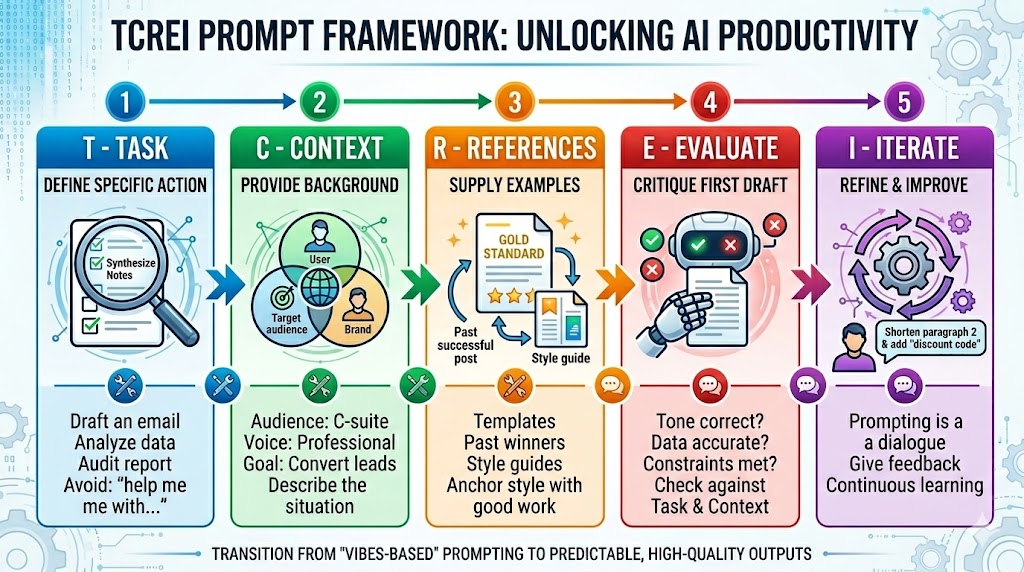
The TCREI Framework (Task, Context, Reference, Evaluate, Iterate) is a structured methodology designed to treat AI prompting as a rigorous process rather than a guessing game. By applying these five pillars, you can move from generic AI responses to high-utility, brand-aligned results.
The TCREI Components
To streamline your workflow, break every prompt into these five distinct phases:
1. Task (T)
Define the objective using precise, action-oriented verbs. Avoid "Help me with..." or "Write something about..."
- Effective: "Synthesize these meeting notes into three executive summaries."
- Ineffective: "Tell me what happened in the meeting."
2. Context (C)
Provide the "who, why, and where." AI performs best when it understands the persona it should adopt and the target audience it is addressing.
- Detail: Specify the industry, the specific problem being solved, and any constraints (e.g., "The audience is C-suite executives with limited time").
3. Reference (R)
Supply the "gold standard." If you have a specific style guide, a previous successful report, or a template, include it in the prompt.
- Action: Provide 1-2 examples of "what good looks like" to anchor the AI's stylistic choices.
4. Evaluate (E)
The framework assumes the first draft is a baseline, not the finish line. Critically audit the output against your original Task and Context.
- Checklist: Is the tone correct? Is the data accurate? Did it follow the formatting constraints?
5. Iterate (I)
Refine the prompt based on your evaluation. AI prompting is a dialogue. If the output is too wordy, instruct it to cut the word count by 20%. If it missed a key point, point it out and ask for a revision.
Comparison: Vague vs. TCREI Prompting
| Feature | The "Vague" Approach | The TCREI Approach |
| Input | "Write a LinkedIn post about AI." | Task: Write a 150-word post. Context: For B2B tech leaders. Reference: Use a "Problem-Agitation-Solution" hook. |
| Output | Generic, "robotic" fluff. | Structured, high-authority, and ready for publication. |
| Time Spent | High (due to constant manual editing). | Low (the AI does the heavy lifting) |
Why Structure Beats Intuition
The TCREI framework is designed for predictability. By standardizing how your team interacts with Large Language Models (LLMs), you create a repeatable SOP (Standard Operating Procedure). This reduces "prompt fatigue" and ensures that whether you are using Gemini, GPT-4, or Claude, the quality of the output remains high and aligned with your business objectives.
Key Takeaway: Stop treating AI like a magic wand and start treating it like a highly capable but literal-minded intern. The more structure you provide, the better the ROI on your seat costs.